


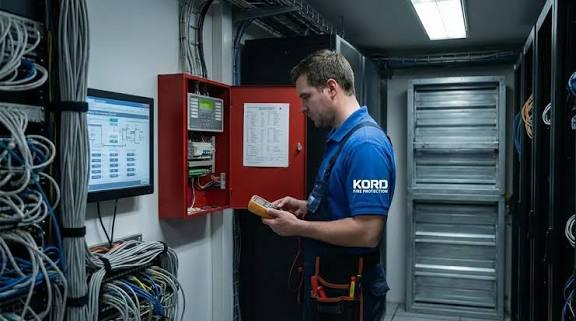
The digital economy runs on physical infrastructure — and that infrastructure is highly vulnerable to fire watch guards. A data center fire is not simply a property loss event. It represents potential disruption to financial systems, healthcare records, communication networks, and cloud services that millions of people depend on daily.
Fire protection in data centers is sophisticated, but no system is immune to maintenance windows, equipment failures, or planned upgrades. During those gaps, fire watch coverage becomes the operational safeguard that keeps critical infrastructure protected.
The Fire Risk Profile of a Modern Data Center
Data centers combine high electrical load density, continuous power draw, and concentrated infrastructure into compact spaces — a combination that creates persistent fire risk. The NFPA identifies electrical distribution equipment and electronic equipment as leading causes of fires in non-residential structures, both of which are central to data center operations.
Suppression systems in data centers are often specialized — clean agent systems, inert gas systems, or hybrid approaches designed to protect equipment without causing water damage. These systems require regular maintenance and periodic testing, during which the facility operates without automated suppression coverage.
When Fire Watch Becomes Mandatory in Data Center Environments
Deploying fire watch guards is not discretionary during system maintenance windows in most jurisdictions. Local fire codes, the International Fire Code, and facility-specific insurance requirements commonly mandate fire watch coverage whenever:
Suppression systems are taken offline for testing or maintenance
Detection systems are impaired due to equipment upgrades
Construction or modification work affects fire safety infrastructure
Hot work is performed in or adjacent to protected spaces
Data center operators who manage facilities across multiple jurisdictions must navigate varying code requirements — a complexity that professional fire watch providers are equipped to handle.
What Fire Watch Coverage Looks Like in a Data Center
Data center fire watch assignments differ from standard commercial patrols in meaningful ways. Authorized personnel must understand the sensitivity of the environment, including restrictions on what can be touched, photographed, or accessed. Patrol routes are typically designed to cover all rows of server infrastructure, electrical rooms, cooling systems, and access points.
Specific responsibilities include:
Visual monitoring for signs of overheating, smoke, or unusual odors
Immediate notification of facility management and emergency services upon any anomaly
Strict adherence to access control and confidentiality protocols
Detailed patrol documentation submitted in real time or at the conclusion of each watch period
The Operational and Financial Case for Continuous Coverage
Downtime in a Tier III or Tier IV data center can cost operators between $100,000 and $300,000 per hour, according to estimates from infrastructure research organizations. A fire event — even one contained quickly — can cause equipment damage, data loss, and extended outages that compound that cost many times over.
The hourly cost of professional fire watch coverage is negligible by comparison. For data center operators managing uptime SLAs and client agreements, fire watch investment is a straightforward risk calculation.
Coordinating Fire Watch With Data Center Maintenance Schedules
Best practice for data center operators involves integrating fire watch scheduling directly into maintenance planning cycles. Before any suppression or detection system is taken offline, fire watch personnel should be briefed on:
The specific systems affected and expected restoration timeline
The layout of the affected coverage zones
Emergency contact protocols for the facility
Any active hot work permits or concurrent maintenance activities
This level of coordination ensures that fire watch coverage is seamless rather than reactive, and that patrol personnel arrive prepared rather than improvising on site.
A Quiet but Essential Layer of Data Center Resilience
Redundancy is a foundational principle of data center design — redundant power, redundant cooling, redundant connectivity. Fire watch coverage applies that same principle to life safety: when automated systems cannot operate, trained human oversight fills the gap.
For any operator managing infrastructure at scale, fire watch is not an afterthought. It is a planned, budgeted, and professionally managed component of a complete resilience strategy.